The Trip
There are cities that have been written about so thoroughly, photographed so relentlessly, and dreamed about so often that the risk of disappointment feels genuinely real before you arrive. Florence is one of those cities. And then you walk out of Santa Maria Novella train station, turn a corner, and the Arno appears — wide and slate-gray in the April morning — and the Ponte Vecchio is just sitting there, exactly where it has been sitting for seven centuries, looking like itself, and you understand immediately that no photograph has ever done it justice. We checked into the Hotel Minerva, a handsome property on the Piazza Santa Maria Novella, dropped our bags, and went looking for lunch. What we found was il Mercato Centrale Firenze, a short walk north of the Duomo — an extraordinary two-floor covered market that has been feeding the city since 1874. The ground floor belongs to butchers, cheesemongers, fishmongers, and pasta makers, all working beneath a soaring iron-and-glass roof engineered by the same architect who designed the Galleria Vittorio Emanuele in Milan; the upper floor opens into a maze of food stalls and wine bars where the city comes to eat at communal tables at all hours. It was busy and a little chaotic and smelling of cheese and cured meat and coffee, exactly as a proper food market should. We ate tripe sandwiches standing at a counter — the lampredotto, Florence’s great street food, braised offal piled onto a salt roll — and started to understand that this was going to be a trip built around eating well and walking hard.
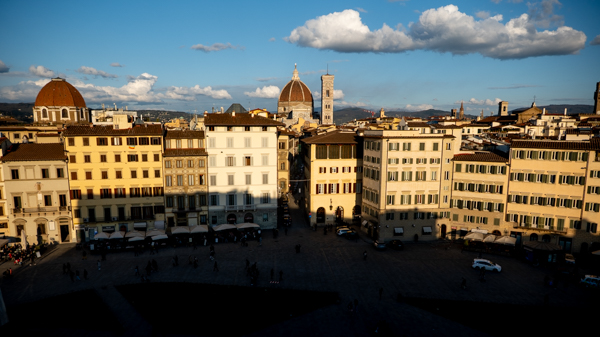
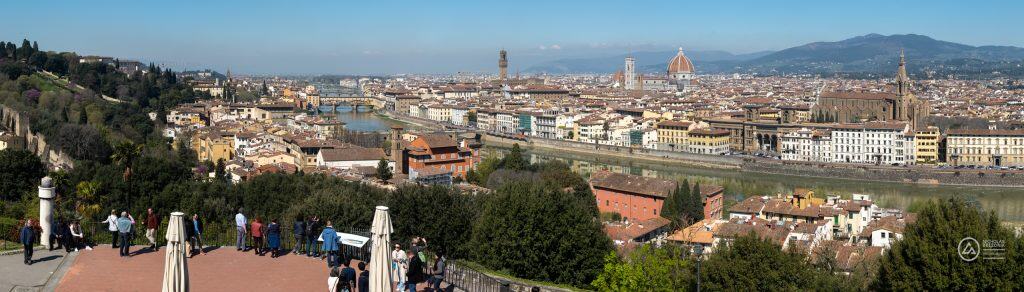
Three nights in Florence is enough to cover the essential ground and still leave time to get pleasantly lost. We ate at Club culinario toscano da Osvaldo, where the Tuscan cooking is honest and the wine list covers the Chianti hills with serious intent. We had dinner at Buca dell’Orafo — a place that has been feeding people in the shadow of the Ponte Vecchio since the 1940s — and it was the best meal of the Florentine chapter: ribollita, bistecca, a bottle of something dark and earthy. The city rewards walkers. One morning we climbed from the Oltrarno up the hill to the Basilica di San Miniato al Monte — a Romanesque church of green-and-white marble that appears to float above the city — and stood at the overlook below it with Florence laid out in every direction, the dome of the Duomo anchoring the skyline, the hills of Fiesole soft and hazy to the east. It is one of the better views in Europe, earned by a climb that most tourists skip. We came back down in time for aperitivo, the early-evening ritual that Florence takes as seriously as any meal. The city has rooftop bars for every occasion, and we found several of them over the course of those three nights — Aperol Spritzes in hand, watching the light change over the terracotta roofscape as the day cooled toward evening. One afternoon we took the train south to Siena — a ninety-minute ride into one of the most perfectly preserved medieval cities in the world. The Piazza del Campo is an argument for civic planning as a high art form, a shell-shaped expanse of brick ringed by Gothic palaces that feels more composed than grown. We gave it a few hours and came back to Florence wanting more.
"The Ponte Vecchio is just sitting there, exactly where it has been for seven centuries, looking like itself — and you understand immediately that no photograph has ever done it justice."
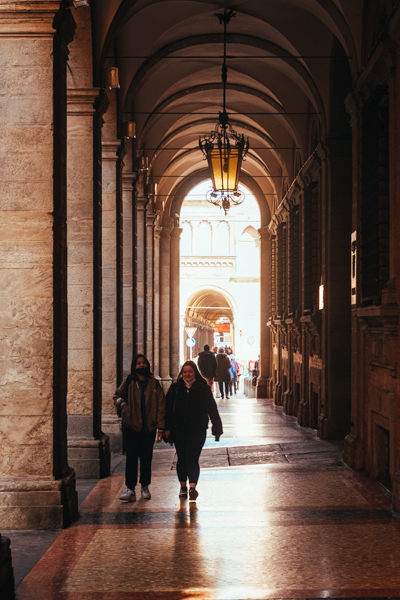
After three days in Florence, we picked up a rental car and headed north to Bologna, a city that doesn't get the tourist attention it deserves, which is part of why it is so good. Bologna is compact and walkable, built for living rather than looking at, with forty kilometers of arcaded porticoes that make the city navigable in any weather. The Bolognesi are serious about food in a way that makes the rest of Italy seem casual — this is the city that gave us ragù, mortadella, tortellini, and tagliatelle, and the restaurants here treat those traditions as points of honor rather than nostalgia. We had good meals, drank good wine in good company, and left the next morning feeling like we'd barely scratched the surface.
After a night in Bologna we drove westward through Emilia-Romagna, with a stop in Parma that deserves more than the few hours we gave it. Parma is one of those Italian cities that has quietly produced an unreasonable share of the world's great food — Parmigiano-Reggiano and prosciutto di Parma are not products of marketing but of centuries of careful geography and craft — and walking its elegant centro storico, past the baptistery and through the piazzas, you get a sense of a prosperous city that has been quietly excellent for a very long time. Then we continued south towards the coast and the Italian Riviera.
Camogli sits on the Ligurian coast about twenty kilometers east of Genoa, tucked into the base of the Monte di Portofino promontory, and it is the kind of place that makes you want to cancel the rest of your plans. The town is built vertically on a steep hillside above a small harbor, its buildings painted in ochres and terracottas and dusty pinks, and the whole arrangement — the colors, the boats, the sea — has the quality of a painting that someone forgot to put behind glass. We had a rental apartment overlooking the water, and the view from it at sunset, with the last light on the harbor and the fishing boats rocking below, was the kind of thing that tends to stay with you. We ate at La Rotonda, down on the port, where the seafood arrives in the most straightforward way possible — just caught, simply prepared, deeply good — with local white wine so cold it sweated the glass.
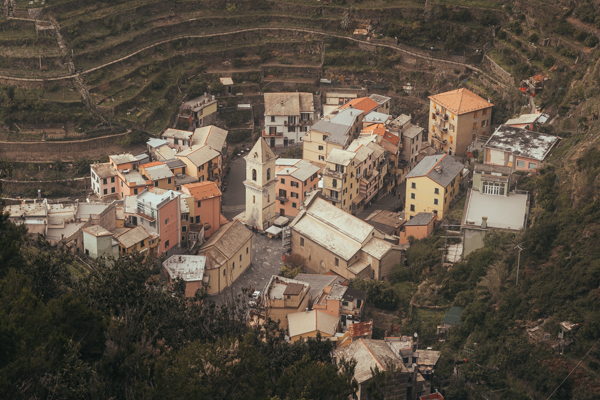
The next day we took the Trenitalia commuter train south along the coast to Riomaggiore, the southernmost village of Cinque Terre, and stepped out onto one of the most improbable coastlines in the world. The five villages of Cinque Terre were built by people who apparently considered sheer cliffs above crashing surf a reasonable place to construct a town, and the accumulated result — terrace gardens climbing straight up from the sea, churches perched on ledges, footpaths blasted into the rock — is either a feat of human stubbornness or a testament to what beauty people can build when they decide the views are worth it. We hiked the trail from Riomaggiore up and over the headland to Manarola — steep, a little breathless, spectacular at every turn — and arrived at the village in time for lunch at a terrace restaurant high above the harbor. The pesto pasta with fresh-caught Ligurian mussels and clams was as good as pasta gets: simple, local, made from ingredients that didn't travel far and didn't need to.
"The pesto pasta at Manarola was as good as pasta gets — simple, local, made from ingredients that didn't travel far and didn't need to."
We finished the trip where we'd started it, back in Florence for two final nights, this time at the St. Regis on the Arno. The St. Regis is a different proposition than the Hotel Minerva — the kind of place where your luggage is carried and your cocktail arrives before you've quite finished asking for it — and it was a fine way to close out the week. On our last full day, we scheduled a food tour that turned out to be the ideal way to understand Florence through its larder. It began at Enoteca Bellini, where we descended into a wine cellar beneath the streets — vaulted stone, dim light, bottles in every direction — and the host poured Sangiovese while we worked through prosciutto and salumi that had been cured with more care than most things I've ever eaten. From there we crossed the Arno into the Santo Spirito neighborhood, one of the less touristed quarters of the city, for a pasta course at Tamerò, a rustic yet modern pasta bar and pizzeria housed in a former auto and carpentry workshop. The evening ended back at Club Toscano for Florentine steak — bistecca alla fiorentina, thick as a paperback novel, cooked over wood, meant to be shared — and finished a short walk away with gelato on a cool April night.
Eight nights in Italy across three regions and five stops, and what stays with you isn't any single monument or museum — it's the accumulation of smaller things. The tripe sandwich eaten standing in a market. The view from San Miniato at midday. The color of Camogli at sunset. The moment you crest the hill above Manarola and the village appears below you and the sea stretches out beyond it. Italy doesn't reveal itself all at once; it unfolds slowly, meal by meal, mile by mile. You just have to be willing to walk.